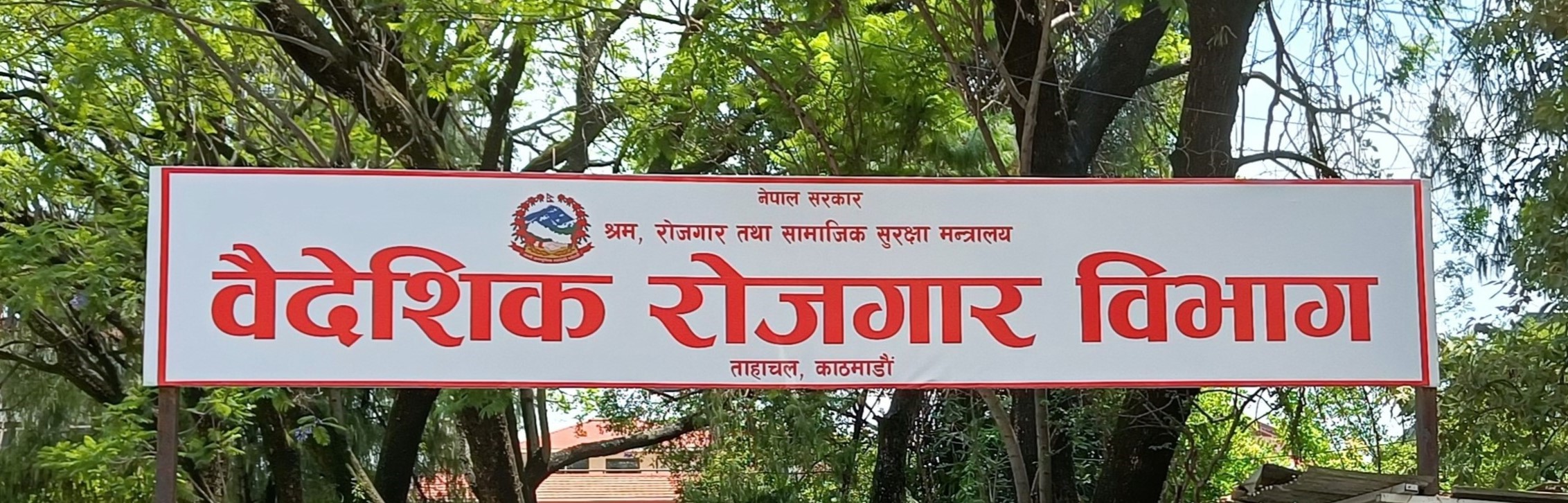


Kathmandu — A recent study has revealed that government-led reintegration programs for Nepali migrant workers returning from foreign employment have failed to deliver meaningful results. Despite policy efforts at federal, provincial, and local levels, most initiatives remain confined to paper and lack effective implementation.
The study—conducted by the University of Amsterdam and the Centre for the Study of Labour and Mobility (CESLAM), Social Science Baha—covered Kathmandu, Dhankuta, Triyuga Municipality of Udaypur, Sangurigadhi Rural Municipality, and Biratnagar Metropolitan City. It found that although returnees gained knowledge from various training programs, they struggled to achieve economic progress due to insufficient start-up capital, limited market access, and lack of continuous guidance.
Researchers noted weak coordination among government bodies and civil society, and highlighted that many returnee workers were unaware of available reintegration support programs.
Presenting the findings at an event organized by the Ministry of Labour, Employment and Social Security on International Migrants Day, CESLAM Research Director Dr. Jeevan Baniya said that sustainable economic reintegration requires quality training, seed capital, long-term skill development, job-linkage mechanisms, and crisis-support systems.
The study also pointed to gaps in psychosocial and gender-responsive support. While reintegration programs focus heavily on economic aspects, they lack mental health services, counseling, and gender-sensitive interventions. Dr. Baniya emphasized that returnees, especially women, face trauma, domestic violence, social stigma, restricted mobility, and limited property rights, yet programs addressing these issues remain inadequate.
The report further highlighted unclear roles of provincial governments, poor inter-agency coordination, and the largely symbolic participation of civil society and returnee workers in policymaking. It recommended strengthening coordination mechanisms, expanding successful local practices, and fostering partnerships with the private sector, NGOs, and returnee networks.
Some positive outcomes were also documented. In Triyuga Municipality, a pilot project under the National Reintegration Policy helped participants better understand financial concepts such as saving, investment, and profit through practical learning. However, challenges persisted, including short training duration, lack of resources to start businesses, and failure to provide promised low-interest loans.
In Dhankuta, a local reintegration initiative provided grants of around USD 1,100 in three installments. While some returnees were able to start livestock-based businesses, many faced setbacks due to livestock disease, family responsibilities, and lack of technical support. Half of the participants failed to establish their businesses, with insufficient grant amounts and the need to take loans between installments worsening their financial burden.
Dr. Baniya stressed the need for a reliable local-level data system for returnee migrants, calling for the strengthening of the Foreign Employment Management Information System (FEMIS), documentation of successful reintegration practices, and regular evaluation of reintegration mechanisms across all government tiers.
The study, based on interviews with 54 returnee workers and 42 stakeholders from three levels of government conducted between March and December 2023, analyzed three major reintegration policies; the Reintegration Program (Operation and Management) Guidelines 2079, the Swiss-funded REMI project, and Dhankuta Municipality’s local reintegration policy.
What’s your Reaction?
+1
+1
+1
+1
+1
+1
+1
1